NFPA 70E Training & Certification: 2024 Edition Compliance
Meeting OSHA Requirements for Electrical Safety in the Workplace
NFPA 70E, titled Standard for Electrical Safety in the Workplace, is a standard developed by the National Fire Protection Association (NFPA) that outlines electrical safety requirements for employees. The NFPA is also well known for sponsoring the National Electrical Code (NFPA 70). Sunvision strictly adheres to all NFPA 70E standards when conducting Arc Flash analysis and Arc Flash studies.
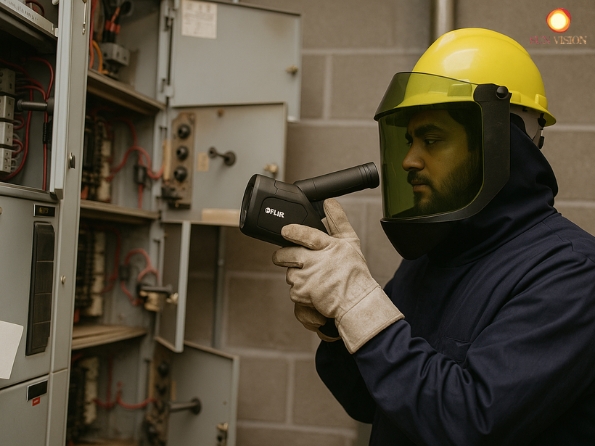
NFPA 70E addresses electrical safety requirements for employees in the workplace, focusing on practical safeguards that enable workers to remain productive while staying protected. The standard covers safety requirements for electrical conductors and equipment installed within or on buildings and other structures, including mobile homes, recreational vehicles, and various premises such as yards, carnivals, parking lots, and industrial substations. It also applies to conductors connecting installations to an electrical supply, as well as other outside conductors located on the premises.
After completing a detailed electrical safety audit and Arc Flash risk assessment, Sunvision provides training to workers on critical safety practices, including proper use of PPE and awareness of danger zones near electrical networks. The National Fire Protection Association (NFPA) was established in 1896 by a group of insurance firms to standardize the rapidly growing market of fire sprinkler systems. Over time, its scope expanded beyond sprinklers and fire extinguishers to include building electrical systems and, eventually, almost every aspect of building design and construction.
Frequently Asked Questions
Q1: How often is NFPA 70E training required?
A: According to NFPA 70E Article 110.6, employees must receive retraining in safety-related work practices at least every three years. However, additional training is required if an employee is observed performing unsafe acts, if new equipment/technology is introduced, or if their job duties change significantly.
Q2: What is the difference between an OSHA requirement and NFPA 70E?
A: OSHA provides the legal "what" (federal laws requiring employee safety), while NFPA 70E provides the "how" (the specific technical standards to meet those laws). OSHA often references NFPA 70E as the industry consensus standard for complying with electrical safety regulations.
Q3: Who is considered a "Qualified Person" under NFPA 70E 2024?
A: A Qualified Person is someone who has demonstrated skills and knowledge in the construction and operation of electrical equipment and has received safety training to identify and avoid the hazards involved. Certification alone does not make one "qualified"; they must also demonstrate proficiency on the specific equipment they will be servicing.
Q4: What are the major changes in the NFPA 70E 2024 update?
A: The 2024 edition includes enhanced risk assessment procedures, updated Personal Protective Equipment (PPE) guidelines, and clearer definitions for safety boundaries (Arc Flash and Approach boundaries). It places a stronger emphasis on the employer’s Electrical Safety Program (ESP).
Q5: Is Arc Flash training the same as NFPA 70E training?
A: Arc Flash training is a critical component of NFPA 70E training. While NFPA 70E covers general electrical safety, shock hazards, and LOTO (Lockout/Tagout), the Arc Flash portion specifically focuses on calculating incident energy and selecting the correct arc-rated PPE.
Q6: Can I get NFPA 70E certification online?
A: Yes, the classroom (theoretical) portion can be completed through our virtual instructor-led training. However, to be fully "Qualified," NFPA 70E requires an employer to verify a worker’s hands-on skills through practical, on-the-job demonstration.